25 July 2011

lucky dog, shiny dog

We are in the Ploschad Revolutsi metro station, deep below Red Square. E has never been here before, and shouts while pointing out the bronze statues in every archway. None of the happy workers are standing. Men and women with guns and scythes, with hammers and noble jawlines. Teenagers run in packs to one of a man kneeling with a rifle and a dog. The dog's face is burnished, luminous in the soft halflight of the metro. They rub the dog's cold nose, laughing, joking, then pirouette onto the next train. 

"Pop." E says, tugging my hand. "I think the dog is lucky."
We approach the statue. 
I lift her up. 
She presses her tiny hands to the dog's face.
I see her wishing. 

We take the next train.
"Do you really think it's lucky?" I ask her.
She shrugs her shoulders.
"Maybe it's just shiny." She says.


Every time I retrieve E, she gives me a long report about what she goes through while she is in her mother's house. Now, she is dragged to some kind of child psychologist every Saturday. A doctor that has never met me tells her I am some sort of monster, that I am a poor excuse for a human. The doctor tells E that her mother is wonderful, some kind of saint. The doctor tells E that she is sad, and that she must not be sad, that children are never sad. The doctor tells E she should help her mother, and go outside in the street and play by herself, cook for herself, and always wear clothing with flowers on it. She tells E she must drink a lot of black tea and wear her hair in braids.

E disagrees, to the letter. She tells the doctor she is not sad at my house, and she is dismissed. The doctor tells her that rock and roll is bad, that America is bad, and that Russia is the only good place in the world.

E cannot wait to turn on the music when we get home, with bags of fruit swinging from our arms. She pogos on the big soft chair in the living room, whipping her hair around. I hand her the tiny guitar I bought her.

"No, Pop!" She shouts. "AIR guitar."

Her face squeezes into itself. A sudden wind swirls through the apartment and a door slams shut. She ignores it all, playing her imaginary power chords, jumping higher and higher.


She dozes off after we eat lunch. I know she is not tired so much as emotionally spent. Her face is filthy. A cat scratch hovers on her cheek. I want to put some antibiotic on it, but think better not to risk waking her. More important she sleep that sleep we all have in our own bed, if only for an hour while the sun walks across the walls.


She dreams.

She turns, hands twisted awkwardly around stuffed animals. I play some guitar, very softly with just my fingertips. I sing her a lullaby.

I want her to sleep all the way until morning, maybe to think that this doctor was a kind of nightmare, but not real, maybe to believe she never left on Saturday and just slept for a long time, that she imagined all of it.


She wakes up late, feet padding to my bedroom door. I am already up before she knocks. I know that sound.

"Pop." She says, holding her arms out to me.

I hoist her up, as she forces her face into the back of my neck. I carry her around the dark apartment, singing the lullabies I have always sung for her. I feel her breath chugging in and out of her tiny body. It slows a little. Her arms go slack around me. I do the old trick of making my way to the hall mirror, looking at our reflection to see if she has really found sleep again.

I sing one more for luck, then fold her back under the light sheet.

In the morning I will eat cold, tiny nectarines I think, as I go back to bed.


18 July 2011

a wedding, some rain


I need to take my hat off, and N's hands are holding a bouquet of twenty nine roses. The ceremony is gaining inertia, as the string quartet has already finished the Mendelsohnn and has somehow started playing Memory from Cats. I wedge my straw panama behind the piano and try to take pictures. The wedding is over as quickly as it started. The room bristles with old ladies and young women's perfume and men thick with cologne. Some are in bermuda shorts, some in crinoline, squeezed somehow into satin and lace, in jeans, in floppy white suits. The groom wears a skinny tie littered with tiny lavender flowers. The bride walks quite effortlessly, pecking cheeks, holding her hands in midair like a ballerina.

I retrieve my hat from between the piano and the wall. The man playing it winks at me once, knowing all too well I was about to forget it. They are already back to the Mendelsohnn as the next group is herded into the windowless room.


We sit in traffic for hours, making our way to the dacha, the country house where the reception will be. My stomach is dead empty. The sun is blinding, and will give N a sunburn on her left shoulder as she weaves along the signless roads. We sing along to The Beatles and Johnny Cash.

The backyard is surrounded by apple trees that lead to a forest. A metal door stands a few hundred feet in, an odd gate that could simply be walked around. I open it all the same and step across the threshold, convinced something magic might happen. N sees a cloud of mosquitoes and shakes her head no. They are biting her naked shoulders already. We go back to the tent, and almost cold wine, to plates of sliced tongue and quartered apples.

The guests arrive in clumps of two and three, finding seats along the long white table. Faces beaming, nodding, toasting, flowers crammed into vases all lined up along the side of the house, bodies wiggling inside sweaty dresses and suits. And then the party bus arrives for everyone without a car, for everyone that plans to get too drunk to drive. The grills are smoking away, soon to be dressed with lamb, then fish then chicken. The fat drips and sizzles as little sparks drift up into the sky, still light now.

I have been trying to call E for hours, standing in the driveway in front of the house to do nothing but listen to the ringing of the phone for a very long time. I dial all of the numbers. I have not seen her for three days now, and only talked to her for a second early in the morning. I want to tell her about the wedding and a funny little bulldog that is tied to the stairs, about the magic door in the middle of the forest, about the pine cones we found on the ground that I will bring to her, about how everyone likes my hat. I want to know she is ok, not being dragged on fake picnics where she eats nothing. I want to know she is safe inside an apartment, not alone in the street like her mother wants her to be now.

I go back to the table, my chair, my girlfriend, her relatives. I go back and drink wine and try to find some peace inside myself. I look at the bride and groom, accepting beautiful and long toasts from friends, their eyes locked. I close my eyes, breathe in the fresh air, slip my feet out of my shoes and grab at the grass with my toes. I make explanations about why they do not answer the phone. It is a game for them, a way to make me crazy, a tactic, a cruelty I would never repeat given the chance.

The meat is served, great bowls of potatoes under a blanket of chopped dill, eggplant, peppers and more wine. Bottles of vodka and whiskey stand like little soldiers every few feet along the table. Some are already empty, and the sun has not gone down yet, just dipping behind the tallest trees.

I will go to the front of the house again, where the kitchen ladies are smoking cigarettes and try to call. The phone will never answer. I will not speak to E tonight. My stomach turns, a black faceless sense of danger creeping across my shoulders. I will imagine her being taken in a car, screaming, with nothing but a sweatshirt. I will see her mother taking her as she has been threatening to - in a plane, to someplace I will never find them. E's face against a window, surrendering the way any smart six year old would.


N rests her hand against my back, massages the back of my neck, plays with the soft fuzz of my freshly shaved head. She tells me everything will be ok, that the phones are off just to drive me crazy, that I will take E the next day, that she is sure of it. She gives me some black tea, tells me to stop drinking wine, to eat some of the meat she saved for me while I stood in the driveway.

I try to believe.

The party grows noisy, as the groom's band turns on their amps and they churn through various cover songs. A guy takes his shirt off and joins them on a second guitar, wildly out of tune but screaming and gesturing so worked up that everyone is jumping in the grass. I see the happy faces, the awkward magic of people dancing, their careless beauty, the slow-motion accidents when someone ends up on their ass, instead of twirling at the end of a fingertip.


In the dark, I hear a sort of cheer and understand the bride will throw her bouquet. The single girls are looking for strategic positions, some more seriously than others. N is part of the bunch, dead center, her heels sagging backwards into the soft earth. All at once the bouquet spins high in the dark sky and two girls cry out, wrestling over the stems and the now shredded flowers. Boyfriends act as diplomats, and agree the girl whose hand caught the stems will take the prize home that night.

And then blind hands are shoving me around the long end of the table, and I join the group of men that stand laughing and nervous. I have been so far outside of my body for hours this night, I hear nothing, just glimpsing faces and when the skinny white gauze is twirling in the air I do not see my left hand extend into a pocket in the crowd, I do not think for a second that my slightly drunk fingers will close at just the right moment and the garter will be mine to take home, to wear like a trophy on my forearm, to make everyone laugh and joke and nudge N.

She smiles at me, her quiet Mona Lisa smile.
She raises one eyebrow, and says "I guess you have something to write about on Monday now, eh?"

The ride home is fast, bumpy. Three in the morning and we are in bed.

A few hours later the sky is already bright. Thunder rumbles. Lightning strikes just across the river. I look at my watch. It is six. I listen to the rain as it approaches, feeling the sudden cool air across us.

In a few hours I call, E picks up, fumbling with the phone. I dress quickly, seeing the rain has stopped, pulling on sneakers and making my way through the empty streets. I buzz the door, E's voice crackles through the old speaker. She is ready, in sandals, jumping into my arms, her face buried in my neck and we go downstairs to buy some corn and some plums. We walk down the noisy sidewalk as she chirps stories in her cartoon voice. We throw kopeks in the first fountain we pass. It starts to rain again and she is laughing, and I hoist her to my shoulders so we can go faster but at one point it is just pouring so we take cover in a bus stop. The drivers are stopping for us and E is waving them on, shouting loud in English. "We're ok! We're ok!"

11 July 2011

ask the rocks

The woman is screaming, her elephant body squeezed into a cheap yellow dress with giant black dots on it. It hangs awkwardly against her lumpy figure the way children's clothes fit a child that has grown out of them. I see the torn collar, her muddy legs forced into tiny shoes that twist her feet sideways. She is grabbing handfuls of rocks and throwing them at him. He has no shirt on, squatting on the backs of his heels, acid-washed jeans and pointy cheap loafers. His hands cover his face, but he does not retreat.

She screams in something I take for Uzbek, or Kazak - not Russian, or maybe Russian with a very thick accent. The rocks and pebbles are hurled with incredible force from her fat fingered hands, the words one long rope of throaty anger. I see a suitcase on its side in the space between them, upside down like a helpless turtle. The zipper is broken. It is wrapped in swaths of tattered cellophane.

The air is electric. The man grimaces. He is completely silent.

I stand there, my canvas bag unrolling in the afternoon sun as it loosens from my hand. The shopping list I wrote flutters to the ground, and I pick it up.

I start to piece an explanation together. They both arrived on the train from somewhere far in the south, traveling in a hot cramped car for maybe two days. Nothing to eat but dried fish wrapped in newspapers, maybe some cervelat, some bread, then nothing at all. He was supposed to arrange a room for them, a car to take them, but he didn't. He just wanted to come to Moscow and somehow she payed for the tickets, and now he will leave her. He will go off with a group of other men, suntanned, with the same shock of black hair, with cigarettes and a bottle to share, with day work and a place to sleep. As they say in Russian, he threw her.

And now she is throwing something back at him.

The glass covered bridge that arcs across the river is only for people, not cars. The day is over and hordes of workers are churning towards home, past these two and their soap opera. No one even looks at them. It is as if they do not exist, or they are invisible. I wonder if I am the only person who can see them.

One of her stray pebbles ricochets off a pole and lands close to me.

He hunches there, not moving. I catch a good look at his face, pockmarked, pimpled. Somehow he is not provoked. His teeth are clenched, but he does not fight back. He does not say a word in his defense, or a word to calm her. Maybe he knows it is impossible.

I understand there could be another story behind this. Maybe he brought her here, this poisonous madwoman, ferried her from far away to a great gleaming city that could absorb her, told her what he needed to, coaxed her with daydreams and half-promises. He packed her bag and got her all the way here, but only to leave her, to lift a rock from his shoulders, to free himself of her in some profound, thoughtful way. Abandoning her like some dog that he hopes will never make it all the way home.

I want to pass them already, to go buy some blueberries from a massive pile in a makeshift market that springs up sometimes here. I want to erase the bleating, dying animal sound of her threats from my ears. I want him to get up, or run off instead of just squatting there and seeing how many rocks hit their mark, drawing blood from his bare flat chest.

I want to forget how I stood in hallways, in doorways, in kitchens with drinking glasses hurled at me, shattering against the walls. I want to forget that I wore the same expression as this man, this sad acceptance, this refusal to surrender, this wish to take a hurricane and douse its fury between nothing but my bare hands.

04 July 2011

the sky in the skillet


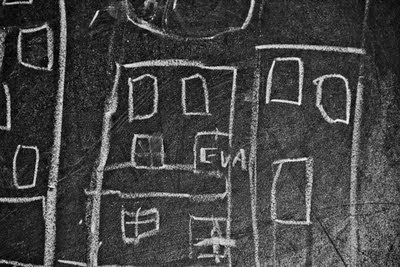
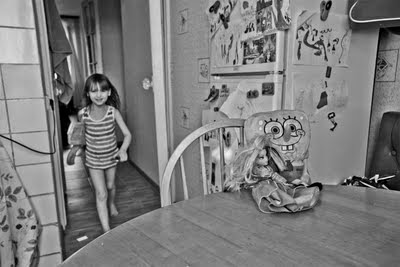
She runs to the kitchen, her bangs suddenly long enough for her to misjudge the door but somehow she slides in behind the table just fine. We have no time as her mother will be downstairs soon, chainsmoking and calling every minute for her to get dressed. But right now, a birthday party is underway. A coffee cake made from a plastic brick of coffee beans is being decorated with plastilene candles. The guests are propped up when they begin to sag sideways. The room smells of the pork roast I have in the oven, smoked paprika and cumin, coriander and a little shake of Old Bay's because I miss home more than usual today. 

She directs me, guides me through the miniature party. She helps the little yellow man make a wish. Her wish. The same wish every time. 


And then she is gone.

The long minute when I go back upstairs is the most difficult. Going back down the courtyard with the sound of my flipflops echoing back at me, avoiding the gazes of the old ladies on their folding chairs, paper fans in their hands. Turning the key in the lock, hearing nothing but the curtains, the low wind flipping the windows around - this is the saddest sound in the world.

Sometimes it feels like all I ever say is goodbye.


I make rice, tortillas from scratch, warm up the beans. The kitchen smells heady, fatty, salty. I sip cold white wine from a tiny glass.

N turns the lock in the door. A sound to break the empty space, the familiar jangle of her keys as she slips into her house slippers, shopping bags swaying from her wrists with fresh avocados and limes I forgot to buy.

I start the guacamole as she sits at the curve of the table, picking at the corners of the tortillas as I grab them from the pan one by one and hide them under a towel. Rolling the next one out in the flour scattered across the table she smells the meat.

"Oi." She says. "Pork again?"

I nod once.

She rolls her eyes.

We will eat it all, barely leaving two tortillas for breakfast and some chilaquiles.


Some people say I am obsessed with food, with cooking, with noodles and spices, condiments and exhausting procedures. N knows better. She knows it keeps me sane. She knows that nothing says I love you like a frittata, or the warm, round flourless chocolate cakes I make at midnight. She knows that if I ever stop cooking, I will stop living. 


Late that night, I cannot sleep. N's face is turned into her pillow, the Aphrodite curve of her stomach glowing in the half-light as I watch her for a moment. I wander into the kitchen, get a glass of water. Walking through the living room, stepping gingerly over E's latest lego masterpiece I stand for some time. 

Yes, I say to myself. Yes.

I put the empty glass on the kitchen table and notice the sky reflected in my giant saute pan. Far too big for the cabinets, it hangs like a trophy on the wall, as if I earned it at one point.