30 July 2012

a confrontation

It is late morning on a hot day and the train is half empty. I know this empty stare set in a round face. This surrender I have witnessed thousands of times here. 
She stands up slowly, gathers her bags and exits. 


In the new market, you must stand with your vegetables in a bag and have someone weigh them and paste a price on them before you check out.
I stand, two zucchini dangling in front of me. An old women is in front of us, not sure one of her tomatoes is worth buying. She allows it, after muttering for some time. Her bag stamped, a different women weasels her bag onto the scale - a few bananas she tosses in front of me. I make one of those sounds New Yorkers make - something between clearing my throat and a collection of half-spoken swearing.
She stares at me.
I shrug my shoulders, as if to say well?
The young man who weighs the vegetables says nothing.
"Ya stayut." I say (I am standing here).
She says nothing.
"Kak etta problem?" I ask (what's the problem).
The round faced women sighs and grabs at her two bananas, taking them off the scale.
The young man weighs mine, and I feel anger growing in me.
"Etta bolshoi mir." I say (it is a big world).
She gets her bananas weighed.
"Puchimu? I ask (why?). 
She sneers for a moment.
"Puchimi ludi ni mogut haroshi?" I call out as she stalks off. (Why can't people be friendly).
My blood racing, E's hand squeezed tight in mine, I look at our shopping list.
"Dad, there are cameras here." E whispers to me. "They can see us."
"We didn't do anything wrong." I tell her, full voice.
She looks up at me.
"Milk." I announce. "We need milk."
I see the woman, skittering around the shelves. She is in no rush, staring randomly at the bread aisle.
Music is warbling from speakers. I recognize the muzak version of the song - I Will Survive.


A few days later, I pass two policemen and a young man in the street. He has a nice bicycle, and they are detaining him, asking for his passport, his registration. He sweats in the morning sun, his round face framed by short black hair.

I think of the woman in the store, so desperate to feel more important than someone else. I think of the men that get stopped constantly here. I see them, heads forced down as they are shoved into police cars. I see them in messy groups by the train station. I see them with their children, on playgrounds pushing swings high in the air.

I think of the woman on the train, and the smell of defeat on her.


23 July 2012

two rivers, three bells, one stone, a king, a tree full of wishes

During the last-minute packing I grab a thin book from the shelf, Rilke's The Life of the Virgin Mary. It is a first edition, bought at the Gotham Book Mart before they closed. A scribbled note to E's mother is tucked inside the jacket. My face hot with embarrassment, I do not read it. I crumble it in my hand and toss it from the balcony like that golden ruble I used to carry. I flits around in the dust on the cracked pavement.

I will force it out of my mind. I will fly away for a few days.
I will look out of windows.
I will feel N's head resting on my shoulder, and the gentle thump of the plane as it touches down.


Lermontov wrote about this place, Jvari. He was exiled to Georgia, and found inspiration in the people, the land, the water. He died shortly after he returned home.

There are angels here. There are yellow butterflies chugging in the sunlight. 

The rest have gone back to the car. I stay behind.

A man can hear his own footsteps here, I tell myself. 
Below, two rivers meet. Cicadas are buzzing in the tall grass. The wildflowers turn in the breeze, and I smell them, sweet and warm. Time has smoothed the corners of every stone, painted them with rain and dirt, with ice, with sun. 

I go inside the church and adjust to the cool darkness inside. Thin candles flicker, pressed into trays of white sand. Visitors trickle in and out of the great doors, passing beneath the unblinking gaze of two angels. A child dressed all in white is carried in on her father's hip. She will be baptized today.  I stand for a long time, drinking the place in. I think of Saint Nino, a brave woman, the woman this placed is named after. I think of N, her skin glowing in the fresh air, back home for the first time in years. I think of her relatives, and their fierce hugs, their generosity, their homemade wine, their long tables overwhelmed with food. I think of the old woman who calls out in the street below our window early in the morning, selling raspberries.
"Malina." She sings."Maaaalina."

I think of E, waiting for me to return. She has agreed to write a story that we can make into a little film, animating bits of plastilene, recording our voices. I wonder if she is making any progress. I wonder if we will be people, or if we will be rabbits in her story. 

Three bells hang outside. They make a funny little family. I try to imagine their sound, in this place older than old. 

The earth is covered in small stones. I lean down and find one, smooth and black, almost round and pocket it.

The path back down the hill is littered with beggars. A woman with a grey cat shades herself behind a sign, her hand thrust out into the sunlight. An old woman in black sits on a tiny stool, her grey hair falling from under a scarf. A man in a big hat gets up, and stretches his legs then sits back down, giving a musical shake to a can with coins in the bottom. 

I give something to each of them.


The narrow road twists wildly, as we pass cows grazing in between the trees. One bull is about to rest, flopping to the grass in a bright patch of sun. He looks like a king to me, with his giant horns and his nose in the air.

Some trees are covered in scraps of cloth. I ask N why and she says these are people's wishes.
"But how do they know what tree to wish on?" I ask.
"It doesn't matter." She says from the back, her hair whipping around in the wind. "Someone starts and then everyone else follows."


16 July 2012

the piano's dream

The two butterflies came back for three more days, flitting through the balcony and circling around the bedroom just after lunch. On the fifth day, only one came and then not at all. Every afternoon after this, I would stand looking out at the busy street, the green water of the river, the stray dogs sleeping in the grass. No black orange wings. No sudden surprises. Just the city churning out smoke, the clouds hanging low, and a strange wind.

There is an odd luck that surfaces sometimes, when life bursts into the unexpected. The methodical waltz is suddenly a dizzy sock hop. Routine is replaced by interruption. The air electrified and we are no longer hungry or tired or thirsty. We are a private version of Richard Dreyfuss in Close Encounters, building mountains from mashed potatoes. The possibilities fan out in countless directions, and we grow drunk on them. And then, it all slides back. The snail in his shell. The socks in the drawers. The dishes are washed. Children are tucked into bed. Someone realizes we need toilet paper. The rent is due in a week. The waking sleep returns.

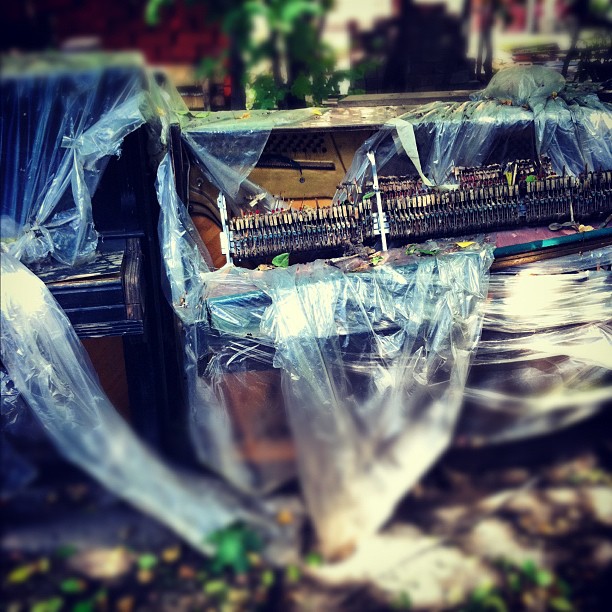
Being surrounded by waste, and what seems pointless is overwhelming. I pass a school for the deaf. The lawn is cut, even in the middle of summer. Maybe the deaf never stop learning here. On the side of the building, a series of pianos sweat under sheets of plastic. They are all broken, sagging into the soft earth, keys dangling, lids ripped off, stinking of mold and rotting wood. I have passed them hundreds of times since I noticed them last winter. Why are they still here ? Who broke all of them? What will happen to them? Will they just be gone one day when I expect to see them?

I am often accused of fixating on the worst here, of magnifying the bleak and ignoring the beauty. I want to defend myself, but my stomach slips into my throat and like it does in many dreams, my voice shrinks to the size of a pinhole.


09 July 2012

everything in its right place

The fire is crackling, spitting. I stand, glazed by hours of hard sun and smoke. N is next to me, prepping the next wave of shrimp. We perform a wordless ballet, with meat and salt, sauce and oil. The knife is always returned to the right of the cutting board. The tongs, in the center of the table. Everything is in its right place.

I stare into the fire, after a careful flip of polenta. A year ago, this was the week when E came back from her mother's house with a new fear in her eyes. Her mother had sold all of E's clothing and toys. She had nothing there but a bare shelf. There were threats that E would be taken to Finland, and never see me again. Furniture was sold, and the car. The roots were being cut, and E returned with tears, her whole body shaking. She sat next to me, resting one hand on my arm at all times as I worked. In the end, the threats slowly evaporated. Why, I do not know. Maybe the idea was just to scare us, to remind us how flimsy our lives are. Maybe it will still happen. Anything is possible. E still has nothing there.

The flames lick the tails, and I flip them. There are hot spots on this mangal, and I am learning them. To cook over burning coals and open flame takes a certain intuition. There are early mistakes, scorched reminders. But if you listen to them, the flavors can be coaxed - smoke and char, sweetness and tenderness.

I watch E playing, her long hair flouncing as she laughs.

The day will unfold with waves of spice and meat, of lemongrass and ginger, lime, chili and garlic. I will collapse into a chair, drink cold wine and stare up at the sky. People will shout, telling me the chicken is burning. I will jump up, make an adjustment. The insects come out, as N slaps at her arms in anticipation. I tell her she is the sweetest, and this is why they bite her the most.

I am spent. The meat devoured, bellies are swollen, shining in the darkness as the coals turn white.


02 July 2012

the children of saudade (drunks and scars)

They built the lopsided shed in random moments, never less than three men with cigarettes dangling from the corners of their mouths. Screws were broken. Warped scraps of plywood were forced into shelves. This patch of dry earth where grass does not grow, and where dogs run to shit is theirs now. Faces round, hair black and straight they stand in a loose group when it is done after days of construction.

I think one good rain will level it.

On the way to take E to school in the morning, the place is closed when all of the other fruit stands are open. This is the exact hour when people buy plums and nectarines on the way to work. There are blue and white plastic sheets shrouding the grotesque little structure. Boxes lean against the plastic. A piece of paper is taped in the center. It says the place is guarded by video cameras. As I crane my neck around, there are none to be seen.

The next day, the sign is gone. They seem to work for just a few hours in the afternoon, a box of rotting tomatoes, some spotty bananas and a wooden crate of muddy potatoes. They leave a young boy to sell things.

I wonder what they were thinking. I wonder about their plans and conversations, about how they felt after it was built or when the first shelf was slathered in white paint. I wonder if they realized that nothing they left there would be safe.

I wonder if they will be there very long.

*  *  *

A man sleeps in the grass by the railway station. The sun is tall in the sky. Zapoi, they call this kind of drunk.

I have taken to carrying my Leica around with me, loaded with Tri-X, a grainy and magnificent black and white film used by Cartier-Bresson and Robert Frank. As I open the little yellow box and load the camera, I catch that very specific odor. It is like ammonia and wildflowers. The promise of a fresh roll is something a young man can get drunk on. It still raises my pulse. Two advances, two fast clicks. Ready for the street.

I look at him for a moment. No one sees me, even though I am surrounded by people. In one motion I check the light with my meter, make a few adjustments. The man has rolled onto his side. His shoes are untied, flapping around like birds on his sockless feet. I crouch and take two shots, varying the frame a little. The camera ducks back into my bag. I don't want the militia or anyone brave to see it. A wave of satisfaction rolls over me. It could be a good one, I tell myself as I make my way down the narrow sidewalk.

*  *  *

A few days later, I see it and it is too empty, too slack. There is no tension in it, no element of surprise. It is nothing more than what it is. I am not in the picture. It is just an idea. In the great ones, you feel the photographer. They are reverse-portraits.  I call this one a building block, a picture that will lead me to another one. Deciphering the chaos of the street here is overwhelming. Every face, every wrinkle, every shirt gaping open with dancing breasts, every well-turned ankle, every mustache deserves attention. I go out with the camera tucked in a jacket pocket or sometimes around my neck like a tourist and go catatonic. The men leering at me might steal it. The police are always perking their ears, and could take it too. This is one object I cannot part with. This is my Leica that I bought one summer day from a fat man who made me smell it first.
"Smells like new, hunh?" He announced across the counter.
I turned it over in my hands, running my fingers across the black body, the focus ring.
"Someday, my kids will have this." I say dramatically, under my breath.
He looks at me and bursts into laughter.
"You're not gonna let your kids fucking touch it!" He shouts, slapping my arm.

E likes to hold it, to raise it gingerly to her eyes, craning her neck forwards as she peers through the viewfinder. She holds it well, with both hands. She pats it the way she does with kittens.

The camera is with always with me now, after living in the bottom of a bag for six years. There were days when I thought it was time to sell it, when the cash in my pockets was so little and the promise of money was so bleak that my Leica represented a month of two of rent depending on how smart I was at selling it. I did sell the rest of the cameras, and it was a smart decision. They paid for lawyers and deposits and food.

Now, I see the little black camera as a reminder of how close we came to something beyond ugly. A beautiful scar.

*  *  *
We come home, with groceries dangling from my wrists. I go to the bedroom to change my shirt and there are two butterflies on the balcony. One sits on the corner of the window, the other flaps furiously as it skips across the dirty glass. It stops, rests. Then the other one jumps up and does the same. I watch them taking turns, and call E to show them to her. 

I cup my hand around one, and guide it around the edge of the frame and it disappears into the sky. The second one is calm, patient. I do the same with her.