29 August 2011

red raincoats and tiny egg rolls


A smile is plastered across her face as she sleeps, blankets drawn to her chin with the windows open. 

She has dimples. 
She is growing up.

I am working long hours, but we find a way to take breaks and run downstairs to kick a ball around, to race up and down the sidewalk, to buy a strawberry ice. E is pure magic this August, spending six days of the week in our place by the river. 

I sigh, and sigh and sigh. How many nights did I stay up late, staring out the windows, haunted by the thought that she lives in the wrong place? It took me some time to understand that even the most foreign place can become a home if there is love and laughter there. It may not be the home I dreamt of, or the home I wanted for us, but this is where we live. At one point I had to surrender, and find a way to enjoy this displaced life. If not for myself then for her, and ultimately both of us.


There is a box of shoes and dresses she has grown out of in the living room closet. There is a plastic christmas tree somewhere here. Red raincoats, Hello Kitty umbrellas, piles and piles of her drawings. There are memories of great meals in our kitchen, chairs crammed into the space like a wooden traffic jam. 

I have intense memories of my childhood, from the age of four. I wonder what her mind will preserve from all of this? The ragtag way we go to meetings together - me half lost, her helping me turn the map the right way? The tiny egg rolls we make together, her spooning the filling into her mouth and tasting the separate ingredients the whole time? Maybe her dolls and how she brings them into the bathtub to act out elaborate stories. Maybe the feeling of waking up and seeing me working on the other side of the room, turning and asking what she wants for breakfast, her stretching her arms to me as I take her and squeeze her and feel her chin resting on the back of my neck.


I write in the bedroom, on a tiny table. She pads in, her pyjamas twisted sideways around her skinny body.

"Pop?" She says, resting her hand on my shoulder.
I look up at her.
"How's it going?" She says. "I mean the Monday story, how is it going?"
"OK." I say, as she curls up on my lap.
I shove the red coffee cup aside so it does not fall.
"You know how sometimes I write a sad story, and sometimes I write a rough one, and then sometimes I write one that is like ah?" I ask her.
She nods yes, even though she has never heard any of them.
"This week is an ah story about you." I say.
"OK." She says, twirling a finger in her messy hair.

I ask her what she will remember of our life here. We talk in hushed, simple sentences about what my parents were like and how I raise her very differently than how they raised me. We talk about what she will be like when she is a teenager.
"We'll be best friends." She says, and starts to cry a little.
Her lower lip curls towards the ceiling, she collapses against me.
"Sometimes we cry because we're just so happy, but in a funny way." I say quietly and she nods a few times.


And all at once it is time to make sure she brushes her teeth, even though she loves doing it. She wants me to stand there in the narrow room, to witness her technique, the methodical child's ballet of swishing water, spitting two times, rinsing the brush, checking her new teeth in the mirror for growth. All at once, it will be September and time to go back to music school, to detskie sad for one more year before real school. All at once it will be autumn and the water in the fountains will get shut off one day. More shoes will be too tight for her feet. Maybe more friends. Maybe new recipes. New jokes, no doubt.

New songs, without question.
And we will never stop singing.


21 August 2011

the red lion (a journey to Kiev)

It is colder here, with a soft rain pattering on the terrace. Waking up in a strange bed in a foreign land, my clothes still packed in my carry-on bag I stare at the ceiling for a while, the blinds chattering against the windows. The apartment smells of old lady perfume and cigarettes. 

Sipping black tea, toast with raspberry jam, a thunderous music swells up from the street. A patriotic chest-pounding Ukrainian anthem. I jump to close the windows, which barely muffles the deep voices that speak now - crude men who will remain faceless. Their words are overpronounced, percussive, brutal comments about Timoshenko. From what I can gather, they are defending her honor. They are explaining, rationalizing, excusing. They are pleading. And then a new voice enters- hostile, furious - repeating a handful of words. I hear kalashnikov and mistake it for the gun, not the politician. I think the enraged man calls Timoshenko a faithful rifle, a weapon. It is my typical confusion, jumping to some poetry, some metaphor when the words are very simple. 

The sound reflects off of the buildings and courtyards in a chaotic mess, the speakers nearly bleeding they are so loud. The double and triple echoes of the speeches become a sort of grotesque nonsense, interrupted by protestors with loudspeakers strapped to their cars. I watch the people of Kiev in the street, ignoring the whole thing. They eat ice creams, sip takeout coffees, and make their way to work. 


The studio is far outside the city, set behind a tangle of apple trees. The shooting will go on for two days, with long stretches of waiting and brief moments of intense thought and concentration, discussion, pointing at screens, regrouping, refining, and then moving on to the next shot. 

I wander the halls of the ancient Soviet documentary studio looking for a bathroom. I glimpse an empty room, odd notes painted on the dim walls, floorboards creaking heavily under my steps. I find old crumbling structures like this one to be warm, kind. There are ghosts here, no doubt, and walls with countless stories to tell. I rest my palms against them, sensing nothing but this, no details, nothing specific, just a deep sense of history.


Tall women totter on stilettos across the cobblestones when we return late at night to grab bread and ham from a market, maybe some Georgian wine. The city is practically humming with strip clubs, with girls hiked up in miniskirts, their eyes wide and dark, staring at me as I jaywalk across an intersection. 

The room is right over a club marked by a red-lit passageway, the Red Lion. The lights blink on and off in the cool air. I do not see anyone entering or exiting. Maybe it is too early or too late for the show. 


The next morning I see girls leaning outside the place, taking long hard drags on their cigarettes, squinting into the horizon above a police station tucked into an alleyway. The girls are all in black now, jeans and sweatshirts, little gym bags resting next to their feet. They do not wear heels.

The speeches begin again, a recording that plays on a loop. They have to shout to hear each other now, even standing a few inches away. The words seem even louder this time, maybe because of the cool, fresh silence before them.

I will fly home in a few hours, back to E and N, back to my guitars and my kitchen, back to my red chair and a sunny bedroom to write in. There are chocolate eggs in my bags, some perfume for N, a job to do, files and sketches and logos. These girls in their black jeans will be here still, and back tonight. I know this is the only work for them here, that they probably support a family in this club. I don't want to imagine what they do inside there. I am a father. I have a sister.

The voices are thundering, desperate in their rhythm. They crescendo and then music plays, lyrical, old. The space between this corrupt politician, with braids twisted over her head and the girls in the red hallway seems very small.

Here, they are all criminals.


15 August 2011

a visit

Jews mixed with Russian Orthodox, the cemetery is a rough jumble of graves. Each one has a tiny fence around it, a crooked leaning mess that reminds me of an empty bed frame. A series of them extend in all directions interrupted by tall birch trees, like a train that stopped abruptly and never moved again.

The air is sweet and still, interrupted by tiny white butterflies that seem to be going nowhere in a hurry. A chainsaw whirs in the distance, and I can imagine its work, the methodical cutting into pieces that thump to the warm, wet earth. The pause when I imagine its owner is going to have lunch now or a late morning tea. And then the chainsaw continues, throaty cut after throaty cut as the work goes on.

Faces are etched in the stones, with mustaches, in fine suits. Women gaze with wet eyes. The impression is that they are looking at me, following my footsteps as I avoid the stinging flowers of krapiva bushes.


Some graves are overgrown, with giant flat leaves thrusting past their fences. Others are kept perfectly, fresh flowers sitting in granite pockets, often a chair or a bench there, glistening under a fresh coat of black paint in the midday sun. At one grave for a little girl that died, a security officer sits. There is gold here, enough valuable objects that the risk of them being stolen is a real one. I understand he has sat here for more than fifteen years.


And now the grave we are here to visit is revealed. Clean, open, simple. The green marble that surrounds it has turned grey in the Russian winter. There are bright shocks of marigold as orange as fresh egg yolks. I smell the wildflowers around us, and a patch of tiny wild strawberries that are close by. Tufts of white puffy seeds float in the air, drifting upwards into a cloudless sky. Hands are pressed to the warm black granite. A handful of stories are told. The eventual silence approaches, when nothing can be said with words anymore, just being here, sitting, watching ants crawling across the dirt, a spider skittering along some plastic flowers over there. 

I see a statue of an angel in the distance. It is made of white stone, and is slumped over itself, weeping.

Yes, here even the angels cry I think to myself.


As we drive away, I feel we have gone too soon. We should have spent more time. 

But now we are on the highway already past the loose string of auto repair garages, past the strange turn with no traffic light. Now I am looking at the hulking shells of buildings half-built, the openings for windows like empty mouths waiting to be filled.

08 August 2011

the kitchen table is all that matters (before and after)

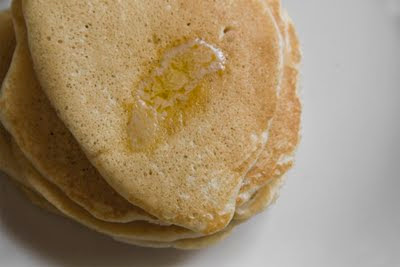
N's head is on my shoulder. The sun has travelled far above the windows. It is late Saturday morning, in an empty house with just the lazy traffic and some dogs barking from downstairs. I kiss her shoulder, let her sleep in. I wander the rooms, make some coffee, splash apple vinegar into the bottom of a white ceramic cup, then top it off with milk. It will sour in about fifteen minutes. It is a new way to make pancakes - light and fluffy, littered with a constellation of miniature holes. My old ones were leaden - dense, moist, and crisp on the outsides. 

There are some plums going bad, so I make a fast compote with cloves and a splash of cognac. The kitchen grows pungent with that intense plummy tartness that pinches up the insides of your cheeks. 

N wanders in, one of my shirts the most suggestive robe. She is not ready for conversation yet, just coffee. I spoon batter into a pan, standing with a spatula on my hip. She tastes the plums and her eyebrows go up. 

As each pancake grows bubbles that then pop, I flip them for a moment then onto plates. N dots each one with Irish butter, knife in hand. It is our Saturday ballet, our slow tango, when eyes meet and no words are spoken. 

Our kitchen table is a dance floor, also a confession booth, a playground, yes with chairs that need fixing, next crusted with dough after I roll out fresh pasta. A worktable, a Lego land, a place to wrap presents. It is where we all sit together, the only place.


I dream that the ceiling is leaking. Chunks of plaster and wood are falling on me, and I cannot do anything to stop them. Waking up in the middle of the night, I feel that rare cold air that washes across us at this hour. I pull the blankets to my chin, try to shrug it off. 

I wake up at nine, calling E, calling her mother. I want to make sure taking her early today is OK, even though I heard her agree over the phone. I have learned to double check everything when dealing with a madwoman who forgets as easily as she changes our plans. The phones are all turned off.

I dress quickly, splash some of the leftover plum on a stale piece of bread and lock the door quietly behind me. I imagine I will be back with E and we can all have breakfast together in an hour.


I buzz the outside door, and they let me in. At the apartment door, I ring the bell. No one answers. I call the phones that are all off. I ring the bell again, then hear it being turned off from inside. The button is useless now. I call all of the numbers again. Nothing.

I bang on the door. I start to imagine E is left alone inside, or everyone is drunk, or maybe E is not even there and they have really kidnapped her. Maybe they took E to some remote village for the month, as they have been threatening to. My hand is tired, but I keep knocking.

Suddenly my phone rings. She asks why I am so early. Before I can remind her that she agreed to this, that I do not enjoy waking up at nine on a Sunday to walk for forty minutes and NOT get my kid, she is screaming that scream. She is babbling in a mix of Russian and English, in that wounded, aggressive tone that I have heard a million times. She is typing out elaborate text messages now, and I reply calmly, reminding her why I am here at this hour. She says she is calling the police. I ask to talk to E. She says E doesn't want to talk to me. I tell her I will talk to E and she can just listen. I say I just want to hear her breathing, as I need to know she is ok. She turns off all the phones again. I go back to knocking on the door. I hear the sounds echoing in the corridor. Ah, the neighbors must be really thrilled right now, I think to myself. But E is more important.

And then something happens that I did not expect. Five policemen are here, bristling for trouble. I stand quietly, calmly. In the best Russian I can muster, I explain why I am here. The door opens, and I glimpse E in the dark apartment. Her eyes wide, I see she is shaking.

The police are annoyed, but official. In a few breaths I understand we all have to go to the station now. There is someone in the apartment - a woman who watches E sometimes, but her mother drags her along, kissing her and whispering to her. I see E's body, stiff and clumsy on the stairs. There is no reason for her to be going with us.

The police put me in the back seat of their car, doors slamming quickly and we are at the station in a few minutes. They talk to me casually, eyes rolling, chins thrust out. I know this is a nuisance for them, but I do not like any of it. In dangerous situations, I have found that I am actually quite calm, maybe too calm. I was held up at gunpoint during a gang initiation in a New York subway station many years ago. I imagined the gun was plastic. I argued with the two teenagers who wanted my wallet, my watch. It turns out they could have killed me right there. The gun was real.

Inside the station, a massive man sits behind a glass window. Both of his hands are bandaged in wild swirls of gauze. Knuckles, thumbs and half of his palms are yellow from iodine underneath the loose fabric. His shock of silver hair stands fiercely.

E's mother asks for forms to fill out. She writes and writes, smiling and laughing to herself. Her face is red. Her hands are shaking. E is crying, squeezed onto her lap. I take a few pictures with my cel phone. E's mother complains to the big man behind the glass. He shrugs his shoulders, tells her I am doing nothing wrong.

I get E's attention, and smile. I shake my head slowly, telling her not to worry. I am talking to myself saying the same thing. I hold out my fingers making the sign of a scissor. She makes the sign of a rock. We play this way for a while, counting to three silently and then seeing who wins. Her mother is oblivious, staring at her paper as she tries to fill the entire page.

She signs it with a flourish and grabs E's chest, running out of the station with my daughter swinging from her arms like a giant rag doll. I leap to my feet, tell the police to stop her. I need her to say what time I will take E today in front of them. They bring her back inside. E's face is red with tears. Her mother is furious. She mumbles that two o'clock is acceptable.

They disappear behind a door.

I sit alone for a few minutes. I tell the big guy behind the glass that I would like to make a statement. I ask to take the paper home so N can fill it out for me. They ask me to wait.

I call N.
"Babe?" I say, in a hushed voice. "Listen - I'm in the police station. Don't freak out. I am going to need help making a statement."
She has gone from sleepy murmuring to wide awake in the time it takes me to say this.
"Sorry I had to wake you up like this." I say.
The big man behind the glass is waving at me.
"I'll call you right back." I say, and hang up.

A young police man arrives. He speaks some English, and invites me upstairs. We take the elevator. I study his short blonde hair, the stubble on his chin. His gun is small, a snub nose hiding inside a worn leather holster.

We sit in a giant room littered with cheap desks. Pictures of wanted criminals are thumbtacked to the walls, flipping around in the late morning breeze. He asks me questions, trying to piece the story together from the beginning. His English is half ok. It is hard to express the details, for him to grasp them. I ask him if I can take the forms home to fill out.

N calls me. She is coming, just looking for the address.

We wait. I learn about his life, how he makes $700 a month, how he still lives with his mother, how he finds a way to have sex with his girlfriend when both of them live with family. He asks me what I like about Moscow, and I say rinok. "Ah, meat." He says, nodding. "Meat is good." I nod wildly, waving my hands around, talking about spices and slow grilling, about how all of the restaurants make me sick. I tell him I write pieces about food and life in Moscow for some websites. "Ah, like Facebook." He says. I nod a little. "Like google, you write for." He says. I decide to agree.

N arrives, her eyes wide as she takes in the big empty room.

We spend more than an hour making my statement, cross-referencing signed documents I have, creating a timeline. He writes carefully, without emotion. Just the facts. We fill a page. He prints it out from the computer, and I must write a long sentence in Russian then sign my name. He wants to help us. He tells me the police are tired of these crazy women making work for them when there are much more important things to do.

Downstairs, the man behind the glass studies N and me. He pauses dramatically then stamps my statement and shoves it in a drawer. I ask if anyone can see this document, especially E's mother. He roars with laughter and says no one will ever see this document.

We thank them, trying to talk through the thick glass. They are already distracted with something else, some information on a screen.

"Ok, criminals - go make some more crimes." The young policeman tells us, cracking a wry smile.

We drive a bit. I play back the whole morning now - my instincts are letting go. I breathe. We have coffee and pastries, our stomachs empty and sour by this time. It is already two.


I take E, her hand instantly squeezing mine. She looks up at me.

"Mom was laughing a lot when we left the station." She says, in a sort of monotone. "She said you are going to prison now, and I will never see you again."

Anger rises in my chest.

"But I'm here now, right?" I ask her.
She nods once, slowly.
"That's all that matters kiddo." I say under my breath.
She stops in the middle of the stairs, holds her arms up. I carry her the rest of the way, sit in the back of N's car with her, trying to crack a few jokes and lighten the mood.

At home, she is starving, having not eaten anything today and it's almost three. We make chilaquiles together, her shredding the tortilla into pieces with a sort of reckless joy, then cracking eggs and splattering the shells across the table. I stare at her for some time, absorbing the truth of her short life. I wonder what she will think of all this when she is older. What will she remember? What will she forget?

I tell myself, she will remember the kitchen table. She will remember some cold grapefruit juice, and a big plate of eggs that we made together.

01 August 2011

two storms


All at once the windows are slamming. Papers flip from the tables. A low hum pushes through the air. Hail is dancing off the windshields of cars below. Thunder cracks beyond the train station. Lightning flashes once, then again. I catch a sour, metallic taste in my mouth, like I am sucking on dirty pennies. 

E is terrified. I go from room to room, closing windows, wiping the miniature floods from the sills. 

"It's the end of the world!" She cries, not joking.

I want to take pictures, but she hugs my legs, not letting me move very far. She does not want to sit under the blankets, or in a corner of the sofa. She wants me to stay in the room. 

"Pop, don't go in the kitchen or you'll DIE!" She says, starting to cry.

I come back, rest my camera on the table. I stare at the messy living room for some time, as she hugs my shoulder and we wait for the storm to pass.


I am anxious these days.

Passing through a crowded parking lot that leads to the market, a black mercedes guns its engine and starts turning, about to crush E and myself against a triple parked truck. I bang on the front fender, shaking my fist in the air. I am yelling in English, not Russian. I point at my child. I give him the finger. He guns the engine, gives me the finger back. The militia next to us say nothing, staring off into the horizon.

E looks up at me, that scared and helpless face she always makes when she used to hear me yell. I hate this moment, this expanded heart-thumping minute, when I find myself furious in the street. Sometimes, it is necessary - literally to keep from getting run over. But the aftermath is the same. A sense of resentment. A sense of failure.


It is raining suddenly again. I am making pasta in the kitchen. I have the music up loud. N is shouting.

She appears in the doorway.

"Get your camera." She says. "Now."

I stumble through the mess of the living room, over E's painting project, maybe crushing the leg of a doll in the process.

Just outside the balcony, a rainbow is hanging in the sky - maybe 100 meters away. You can see everything. The base where it blooms from the river, the arc now echoed by a second rainbow that fades off. I click randomly, out of focus, overexposed. I am laughing at myself. N raises an eyebrow, amused as always.

People on boats in the river are shouting. Cars are honking. The streets are wet, shiny.
I set the camera on a chair and just look instead, holding N's hand.

In a minute, it is already gone.